

For many journalists, freelancing is a choice.
I know full well that I’ll annoy some people with that phrase; if you’re starting out in your career, freelancing may be the only way to try and get a toe on the ladder towards the Holy Grail of a staff job. But for folk like me, who have enjoyed the security of a salary for decades, going solo was my choice. I’m exceptionally fortunate to have taken a voluntary redundancy package that allowed me to break free.
But blimey, getting a gig is an uphill process. And it doesn’t help that the BBC has decided to close one of its freelance doors this week. The Talent Cloud, set up a few years ago, was a place where you could register your personal details, along with your skills and the types of jobs you were qualified to do. Using myself as an example, I would list radio newsreading and reporting, presentation and online writing.
The theory was that the Talent Cloud would allow any manager in the BBC to hire the right person for the job, acknowledging that many freelances have a portfolio of skills that could overlap different parts of the organisation. Had my mind fancied it, I could have also registered as a runner for Garden Rescue (or at least a broad range of location based productions).
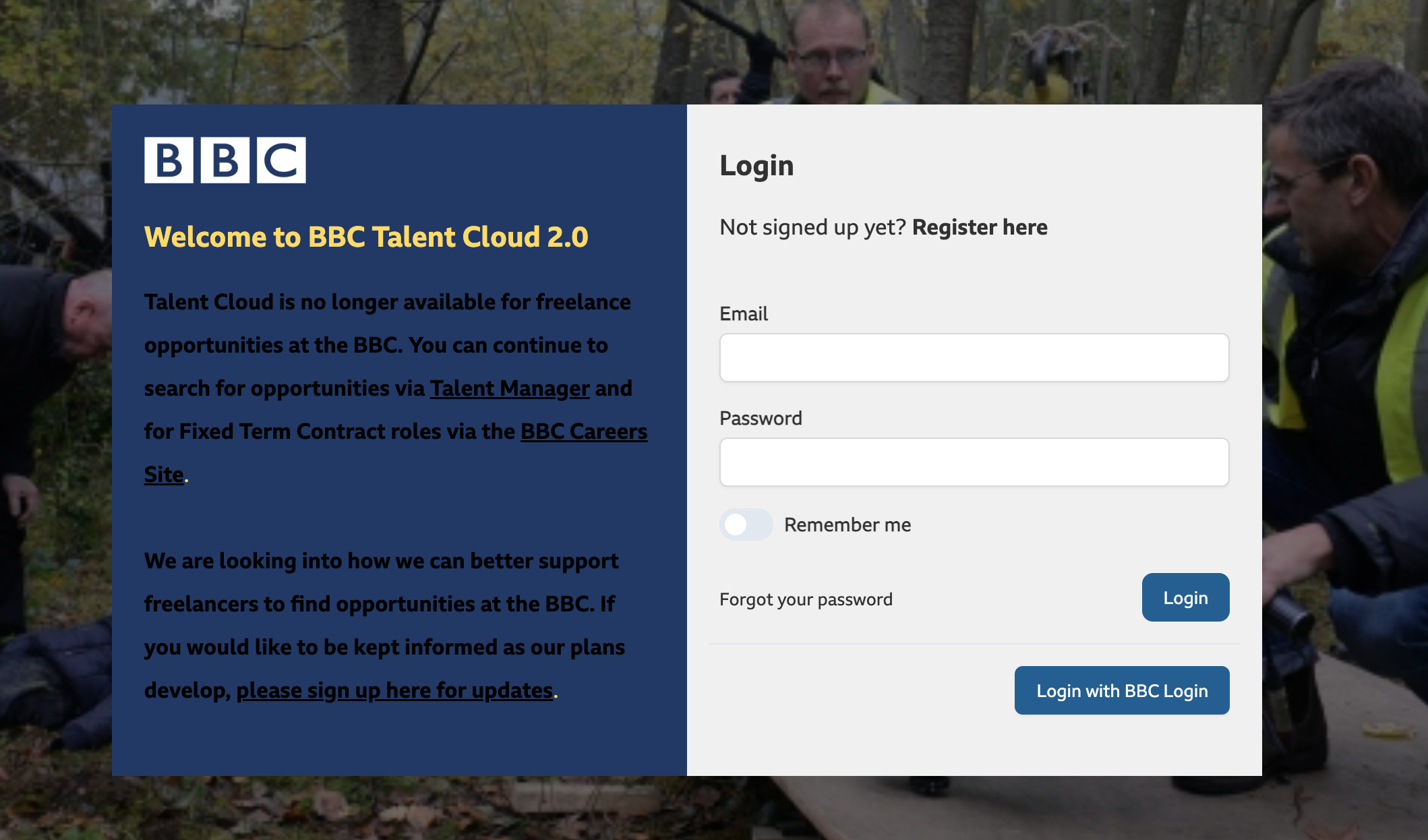
But last week, all freelancers registered with the Talent Cloud have been told it is being “retired”, and so far there is no like for like replacement. None of this surprises me, because for years the BBC has been trying to solve the complex issue of what it calls “the extended workforce”.
The main issue is scale and scope. The BBC has over eight hundred job titles, covering the huge range of tasks required to produce thousands of hours of broadcasting output, digital and online content and, of course, the array of technical gubbins that goes with a massive communications infrastructure.
As the Nations and Regions rep for the National Union of Journalists, I sat through hours of presentations from senior managers who were trying to document this army of workers and map it out into some form of logical process, whereby everyone would be paid a fair rate for the job. After almost two years of undocumented behind the scenes activity, the most senior of those managers came back to the Unions to say that no actual plans had been drawn up. The Union reps were flabbergasted, but ultimately not surprised.
That’s the biggest sticking point. There is no such thing as a fair rate for the job, or at least one that everyone can agree on. The NUJ’s London Freelance Branch ambitiously has an online tool where various day rates and word count rates are shown for all kinds of media outlets. But it relies on self-reporting, with many of the figures hopelessly out of date.
Even in a relatively small, definable section of the BBC there is often little or no consistency. A Nations and Regions Journalist (with a capital J, BBC Grade C) can earn one of two day rates for an eight hour shift - the higher one paid for the more experienced. But those rates have barely changed in the past decade. And where they have increased, this has happened through arbitrary decisions in individual departments. The Unions’ collective bargaining rights do not exist for the “extended workforce.”
For the BBC’s part, I know from experience that every single department is always trying to cut its freelance spend, but often hopelessly fails. Last year, Nations and Regions cut a number of staff weather presenter jobs and insisted that many who were working four ten hour days would move to five eight hour days. The Unions were categorically told there would be “no freelance budget”. Months on, the remaining staff are run off their feet, with many working extra hours just to ensure each English region gets its weather forecasts. The outlook is indeed gloomy.
So now a new review is in progress, codenamed Project Kodiak. I never did find out why it was named after an Alaskan grizzly bear, and it would be entirely wrong to suggest it related to any individual involved in the process. What I do know is that after a further eighteen months we were no closer to getting a plan of action. In an ideal world, the solution would be a published Rate Card, clearly setting out daily and weekly fees for any given task. Another side of freelancing is those who are hired for fixed term projects, which again need to be quantified in terms of worth.
In the meantime, freelancers have been informed that the Talent Cloud is “being retired” while the BBC decides on a replacement. Anyone on the existing system can register an interest to be included on the new one, but the whole timing leaves a huge void. My own suspicion is that few BBC managers were actively using the Talent Cloud; I certainly had no bookings from it. It’s entirely possible that money was spent on a system that few knew about.
The standard email sent out this week suggests we look for work via a third party website where opportunities are posted, or to check the BBC Careers website. Of course, with more massive cuts looming the number of opportunities may become increasingly limited.
None of this is unique to the BBC. Many big outlets know the freelancers need the shifts, and are often more flexible than their own in house staff. Pay in the broadcast news sector is annoyingly stagnant. But after years of debate, the BBC really does need to come up with a solution that matches talent with a fair and equitable rate for the job, and do so quickly.
With many universities now cutting Journalism courses, broadcast risks a skills shortage; one that can only be met by experienced journalists who can master the tasks required to keep high quality, trusted news content.